BEIRUT — Fiber-optic First Person View (FPV) drones operated by the Iran-backed armed group Hezbollah have changed the battlefield in southern Lebanon, inflicting losses and causing damage to Israeli forces occupying parts of the area.
The technology, a hallmark of the fighting in Ukraine, arrived here shortly after Hezbollah launched an attack against Israel on March 2, following the U.S.-Israeli war against Iran that began days prior, reigniting a new large-scale war.
The tethered drones rely on a spool of fiber-optic cable that maintains a direct link between the operator and the aircraft, making them immune to jamming and to other regular electronic warfare measures. In the context of southern Lebanon, their appearance represents a major shift in the nature of the conflict.
Hezbollah released the first video footage of a fiber-optic drone attack on an Israeli tank in late March 2026.
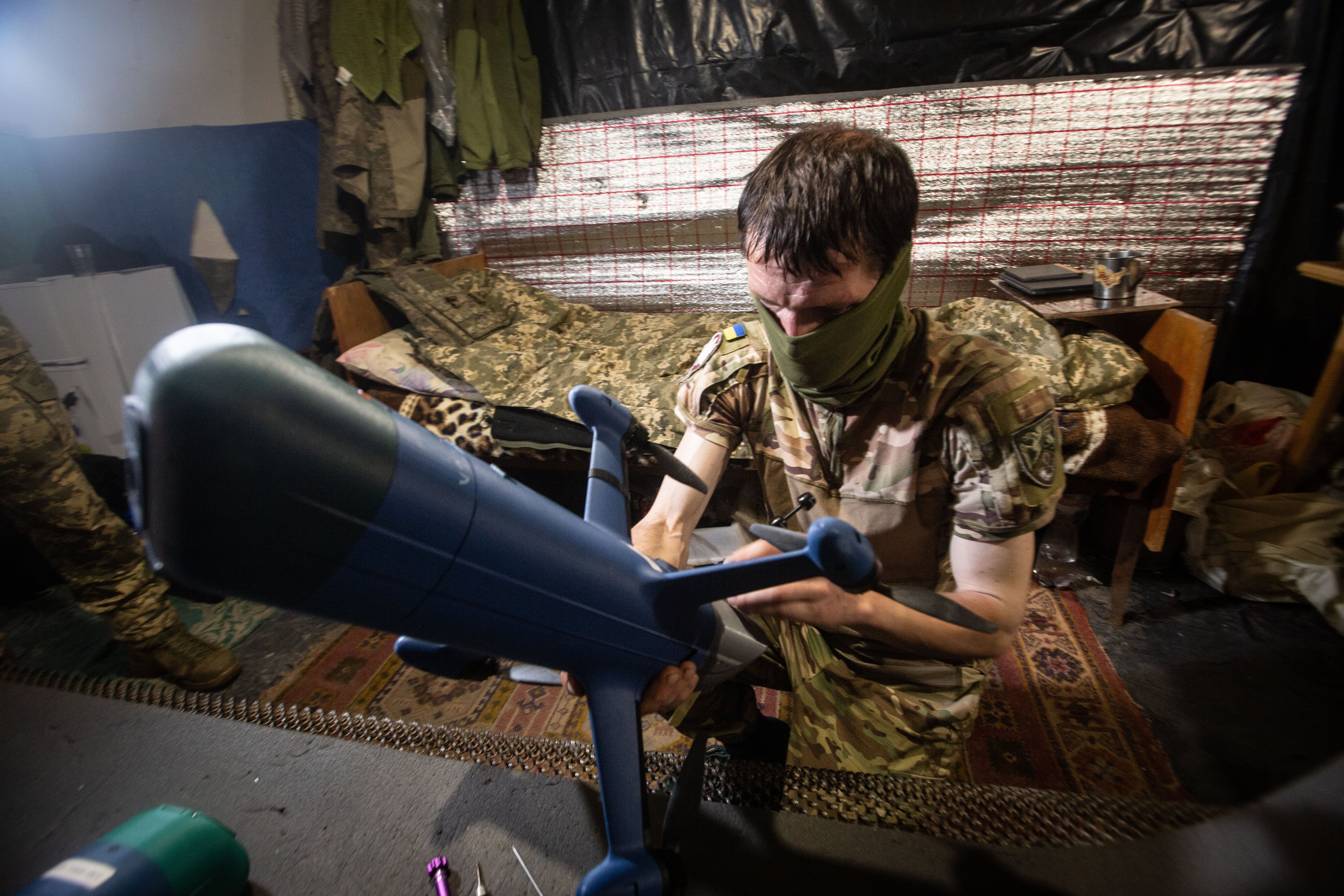
Asked about the technology, Hezbollah referred to Ali Jazini, a military expert close to the group, who said that the drones are estimated to cost between $300 and $400 each. The craft appear to be manufactured locally using 3D printing technology, relying on available electronic components commonly used for civilian purposes.
“Hezbollah is one of the most sophisticated non-state actors in the world. But when it comes to FPV’s drones, they’re learning themselves,” Samuel Bendett, a military analyst and Russia defense expert with the U.S.-based Center for Naval Analyses, said.
Fiber-optic FPV drones have quickly become a critical weapon, and the only real requirement is having experienced operators, as improper handling can easily damage the cable.
“But if you are in your 30s or 40s, you grew up with PCs and PlayStations and know how to maneuver a joystick,” said Luxembourg-based defense commentator Hamzé Attar.
As part of the growing gamification of warfare, simulation tools now allow operators to train across a wide range of scenarios, significantly shortening the learning curve, “ultimately enabling Hezbollah to also deploy night-vision-capable FPV systems”, he said.
Fiber-optic FPV drones represent a solution born out of necessity to evade electronic warfare and enable more precise strikes, after the group’s supply line from Syria was disrupted following the fall of Assad regime. These drones do not require runways or any specialized launch infrastructure, and they also allow the pilot to retain visual contact with the target until the final seconds before impact.
Intelligence about launch sites and a pilot’s location is significantly more difficult to obtain than intelligence on other drone activity, and actors are banking on that asymmetry.
In that sense, Israeli forces seem to have been caught flat-footed. “No one is more aware of technological and drone developments around the world than Israel,” said Bendett. “So it was rather surprising to see the Israeli military not fully accounting for the potential use of these drones.”
This created a battlefield advantage for Hezbollah, alongside its deep familiarity with the terrain and geography of southern Lebanon.
Knowledge transfer of technologies and tactics typically occurs through multiple channels, including observation of other battlefields, widely available open-source footage, and training, according to analysts. Some of the expertise developed in Russia may have been transferred to Iran, and passed on to Hezbollah.
“Just as Iran has supplied technology and training for Russia’s use of Shahed drones, it is likely that Iran may have received training from Russian forces on the use of certain types of tactical UAVs”, Bendett said.
Analysts believe that any military engaged in conflict will, in one form or another, encounter technologies first seen in Ukraine, driven in part by the trade-off between efficiency and cost.
“We are seeing some of that in conflicts across the Middle East, Africa, the Sahel, and South Asia. We are also seeing the use of drones by drug cartels in Latin America,” Bendett said.
Countermeasures against the flying warheads include nets, acoustic warning sensors, spinning cables, or electromagnetic systems intended to disrupt electronics, but such measures can also risk affecting a force’s own assets operating in the same area.
According to Jazini, solutions remain limited at present, even for larger armies.
Said Attar: “They changed the battlefield and will continue to be a destabilizing factor in warfare until a proper solution is found.”
Agnese Stracquadanio is a Middle East correspondent for Defense News. She has a background in writing and photojournalism, holds a master's degree in international relations, and previously worked for Reuters.